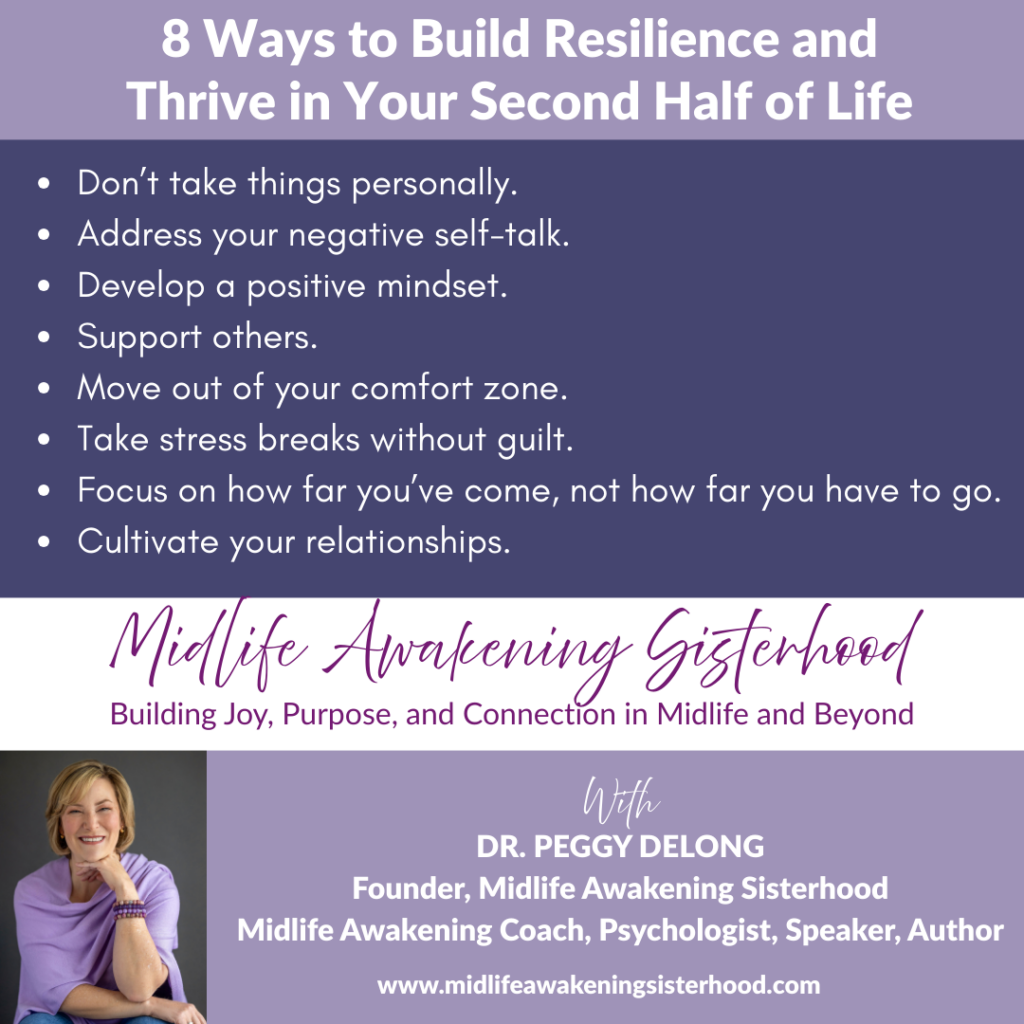
8 Ways to Build Resilience and Thrive in Your Second Half of Life
Building Resilience in Midlife: Your Path to Strength and Renewal
Midlife can feel like standing at the intersection of loss and possibility. Perhaps you’re navigating the profound grief of losing a parent or spouse. Maybe you’re facing the disorientation of job loss after decades of expertise, or watching the life you built shift as children spread their wings. Financial worries might keep you awake at night, and concern for your children’s wellbeing, their struggles with anxiety, school, or finding their way weighs heavily on your heart.
You’re not alone in feeling this weight. And here’s the truth that matters most: Resilience isn’t something you either have or don’t have. It’s something you can cultivate, strengthen, and grow, at any age, at any stage. Join us in the Midlife Awakening Sisterhood for community, 1:1 support, and transformational curriculum of insights, skills, and strategies for lifelong wellbeing.
Eight Research-backed Pathways to Strengthen Your Resilience
- Don’t Take Things Personally
In my 30 years as a therapist, I’ve seen how taking things personally, especially in midlife, can quietly cause deep emotional pain and derail dreams that women have waited decades to pursue. When you’re navigating changing roles, shifting relationships, or redefining who you are beyond caregiving and achievement, it’s easy to internalize disappointment or rejection as a personal failure. True resilience requires understanding this distinction: when someone is harsh with you, when they disappoint you, when they seem to pull away or reject you, take a pause. Their words and actions are almost always about their own pain, their own fears, their own story. This doesn’t mean that it doesn’t hurt. It means you don’t have to carry that hurt and the weight of others’ struggles as evidence of your worth, or as a reason to shrink your next chapter.
If you need help with this (and most people do!), check out the chapter Don’t Take Anything Personally in The Four Agreements by Don Miguel Ruiz, or chapter 19 “Don’t Take Things Personally” in my book, Feeling Good.
2. Address your negative self-talk.
Listen. Really listen, to the narrative running through your mind. What are you telling yourself about who you are and what your life means? Often, we’re our own harshest narrators, replaying old scripts written by fear or past hurt. You have the power to question that voice, to challenge it, and to reframe how you view yourself with compassion and truth. Your past doesn’t have to define your future.
In the Midlife Awakening Sisterhood, I teach about negative thoughts and what to do about them, including The Unkind Mind, The Negativity Loop, and The Brain Reset Button.
For support in this area, I recommend the work of Kristin Neff for building self-compassion.
3. Develop a Positive Mindset
This isn’t about toxic positivity or pretending pain doesn’t exist. It’s about intentionally seeking moments of light, choosing thoughts that serve you rather than diminish you, and surrounding yourself with people who see possibility alongside struggle. Optimism is like a muscle. The more you use it, the stronger it becomes. Gratitude is my favorite way to develop a positive mindset. Over time, with a daily gratitude practice, you are truly rewiring your brain to become a more positive thinker.
But a strong positive mindset is so much more than just positive thinking. In the Midlife Awakening Sisterhood, I call it The Positive Mindset Grid. Other crucial components of the grid include: 1) addressing those pesky negative thoughts, 2) knowing ways that elevate your mood, and 3) the often overlooked crucial component of feeling and processing your emotional pain. Lessons include The ABC Method to Combat Negative Thinking, The Joy Generator, and The Happiness Lie.
For support in this area, check out chapter 27 “Develop a Positive Mindset” in my book, Feeling Good.
4. Support Others
Here’s a beautiful paradox: resilience grows strongest not when we’re simply supported, but when we give support to others. It doesn’t require grand gestures. It can be a simple text to a friend to check in, listening without trying to fix, sharing a meal, offering your presence. When you extend your hand to someone else, you discover your own strength. Purpose and meaning aren’t “found”; they’re created through meaningful human connection.
But many women in midlife are so busy giving to others that they forget to take care of themselves. In the Midlife Awakening Sisterhood, we address this through the lessons The Empathy Error, Empathy Flow, and S.E.L.F.-C.A.R.E. – so that you’re in the best position to give to others in ways that fuel you rather than deplete you.
For support, check out Chapter 12 “Give to Others,” and Chapter 29 “Practice Self-Care” in my book Feeling Good.
5. Move Out of Your Comfort Zone
Growth doesn’t happen in safety, although your brain wants to keep things comfortable and safe. Growth happens in the stretch. Moving out of your comfort zone can be practiced in fun ways! Book that trip you’ve been dreaming about. Go by yourself to a coffee shop. Share your voice. Try a new recipe. Reach out to someone new. Learn something that scares you a little. When you intentionally create challenges on your own terms, you build confidence in your ability to handle the challenges life throws at you unexpectedly.
For a wonderful book guiding you through self-discovery and moving out of your comfort zone, check out The Artist’s Way by Julia Cameron.
6. Take Stress Breaks Without Guilt
Stress isn’t the enemy. Stress is part of life. But chronic, unmanaged stress will deplete you. Give yourself permission to step away. Meditate for five minutes. Meet a friend for coffee. Take a walk where you notice the trees, water, and awe. In the Midlife Awakening Sisterhood, I call this The Trifecta of Exercise in Nature. Breathe deeply and deliberately. And then, this is crucial – release the guilt. Rest is not weakness. It’s wisdom. Research demonstrates that highly resilient people: 1) know when to take stress breaks, 2) actually take those stress breaks, 3) and then don’t feel guilty about those stress breaks!
For support, check out Chapter 2 “Get Outside in Nature,” Chapter 4 “Be Creative,” and Chapter 30 “Do What Makes Your Soul Happy” in my book, Feeling Good.
7. Focus on How Far You’ve Come
Look back at your life. Really look. See the moments you thought would break you, but didn’t. The heartbreaks you survived. The challenges you met. The impossible days you got through. You have a history of resilience already. Let your past strength remind you of your present capacity. You’ve done hard things before. You are the same person – you can do hard things again. If you have difficulty saying kind, supportive words to yourself, try The Best Friend Technique – what would you say to your best friend in a similar situation as you? Now say those supportive words to yourself!
In the Midlife Awakening Sisterhood, we address The High-Achieving Cycle that get women stuck, and The 3 Ps Method to Combat the High-Achieving Cycle, so you can finally stop doubting your strength, release the need to prove yourself, and move forward with clarity, confidence, and self-trust into your next chapter.
For support, check out Chapter 32 “Focus on How Far You’ve Come, Not How Far You Have to Go,” in my book, Feeling Good.
8. Cultivate Your Relationships
Research shows that the strongest predictor of emotional and physical wellbeing is the depth and quality of our relationships. For women in midlife, meaningful connections are more important than ever. They provide support as we navigate changing roles, shifting family dynamics, and new personal or professional goals. Investing in relationships with friends, family, and peers who truly see you, listen without judgment, and cheer you on helps you stay grounded and resilient. These connections offer perspective, encouragement, and a reminder that you are not facing life’s challenges alone. When you nurture these bonds, you create a network that strengthens your courage, fuels your joy, and gives you the confidence to step fully into your next chapter.
In the Midlife Awakening Sisterhood, lessons include The Connection Injection: 10 Ways to Foster Closeness in Midlife Friendships, the Reach Out Reach Hearts Method, Awkward Efforts Awesome Connections, and more, to support you in deepening your relationships.
For support, check out Chapter 8 “Connect with People” and Chapter 10 “Surround Yourself with People Who Make You Feel Good” in my book, Feeling Good.
Your Journey Starts Now
Building resilience isn’t about becoming unbreakable. It’s about learning to bend without losing yourself, to adapt while honoring what matters most, to find strength in vulnerability and connection. This is what really matters for lasting wellbeing.
The Second Half of life can be your most vibrant, purposeful, and joy-filled chapter yet. It takes courage, community, and compassion, especially self-compassion. If you’re someone who’s spent decades caring for everyone else while holding yourself to impossible standards, this might be the most important work you’ll ever do. In the Midlife Awakening Sisterhood, women are discovering how to silence their inner critic and speak to themselves with kindness. And they tell me it’s transforming everything.
You’re already more resilient than you know. Now it’s time to claim that strength and build upon it. Contact me to set up your free call to learn more about the Midlife Awakening Sisterhood: peggy@midlifeawakeningsisterhood.com
In Gratitude,
Dr. Peggy
Join us in the Midlife Awakening Sisterhood, a community where we support each other in building resilience for our best lives in midlife and beyond. You don’t have to do this alone, and you don’t have to wait another day for support. Enrollment is open, and we welcome you with open arms to join us in “The Sisterhood.”
I invite you to explore these powerful resources:
- Joyspan: The Art and Science of Thriving in Life’s Second Half by Dr. Kerry Burnight
- Resilience: The Science of Mastering Life’s Greatest Challenges by Steven Southwick, MD and Dennis Charney, MD
- Option B: Facing Adversity, Building Resilience, and Finding Joy by Sheryl Sandberg and Adam Grant
- From Strength to Strength: Finding Success, Happiness, and Deep Purpose in the Second Half of Life by Arthur C. Brooks
- Feeling Good: 35 Proven Ways to Happiness, Even During Tough Times, by me 😊
Leave a Reply