8 Gentle Truths for Thriving in Midlife and Beyond
A couple of years ago when I became an “empty nester,” the silence in the house was deafening.
Our oldest child drove one of the family cars to college for her Senior year. Two days later, we dropped off our son for his first year of college. The next day, I dropped off our daughter for her Junior year of college.
The next morning, I walked down our creaky staircase. The same steps I used to tiptoe down when they were babies, or the creaking would invariably wake up a little one too early when they were 4, 3, and 1 year old.
After they left, there was no one to wake up. The house was uncharacteristically quiet that first morning with all three of them gone. An uninvited quiet. I looked at my husband, and I could see in his face that he felt it too.
With the realization of the change in how I maneuvered the creaking steps, I felt the weight of one of their overstuffed blue Ikea Frakta bags hanging from my heart.
“How did two decades go by so quickly?” I wondered. Suddenly, I was labeled an “empty nester.” But I’ve never cared for that term. Why define this season by what’s gone, rather than by all that remains and all that’s still possible?
While raising our children to be independent and leave the “nest” is the goal, whether that be for college, military, or a job, some moms have a harder time than others. I am one of them.
Grieving children who are no longer living at home is a form of “ambiguous grief.” They are still very much alive, yet their absence is deeply felt. It can also be a kind of “disenfranchised grief,” because you’re often expected to feel only pride and happiness about their independence. That expectation leaves little space to acknowledge the sadness or to speak openly about the loss. And without that space, this very real grief can go unseen and unsupported.
I decided I didn’t want to feel “empty.” I could miss them terribly and feel my grief, yet I knew I did not need to feel “empty.” I started by avoiding the term “empty nester.” The social media algorithms must have been reading my mind, because a beautiful poem came across my feed.
“My role is no longer to be their sun. My job is to be their moon, connected by a force so strong, it will never break. I will follow along, providing light at the darkest moments, directions when needed. Sometimes my presence is large and looming, and sometimes it is small, barely seen by the naked eye. But I am always there.” – Author unknown.
After reading this poem, I created this term for myself – “Moon Mom.” I’m not an empty nester. My children may not need me like they used to, but I’m not going to allow my life, or my home, my “nest,” to feel empty. And like the moon, I will always be there for them.
I knew I must not be the only one feeling this way, and I knew that as a psychologist, I had support and education to offer other moms. So twice, I ran a brief 4-week session during two Octobers to support other Moon Moms. It was wonderful.
Fast forward two years. My oldest graduated from college and moved back home for her gap years, working locally while applying to medical school. (Yahoo! She was accepted and will soon be heading to beautiful Montana to become a doctor… cue the bittersweet wave of anticipatory grief that comes with knowing another goodbye is on the horizon).
My middle child graduated from college and is living at home while she attends graduate school in Speech/Language Pathology.
My son did not think that his college was a good fit for him, so he moved back home while he attends county college.
I am loving having all three of my adult children living at home. I know it won’t last, and I’m savoring the family dinners. Now, they’re unhurried – no sports to get to. No PTA or Scout meetings to rush off to. And once again, two decades later, I unexpectedly find myself tiptoeing down the creaky staircase so that I don’t wake them up, and they can sleep in on a Saturday morning. I still remember how precious that felt as a busy young adult!
Some things have definitely come to light during the past couple of years. I’m turning 58 this year. My father died one month after he turned 58 from a sudden heart attack. My husband’s brother suddenly died at 57 from a stroke. Healthy one day, gone the next. My fiancé died at age 27 from an aggressive form of cancer that took his life in just months. My mother died 9 months ago. Although she was 83 when she died, she was vibrant and active until the very end when she got covid.
I know how precious life is, and I know how things can turn on a dime.
I realized that I’m in the “Second Half,” and I’m determined to make this the best in can be – for myself, for those around me, and to honor those who didn’t get that chance.
With my 30+ years in mental health, I’m in a wonderful position to do so. And to support others in doing the same.
Over three decades of working closely with individuals and groups, I’ve listened deeply to women’s stories, identified their most common pain points, and distilled what truly helps into research-backed practices that work in real life. From that experience, I created my proprietary Prioritize P.E.A.C.E. Method. Through creative, engaging, and highly effective tools, this method supports midlife women in rebuilding joy, deepening connection, and rediscovering purpose, making your Second Half of life not just lived, but deeply meaningful and fulfilling… all while gently inviting you to reconsider what those things means now, because this season of life is calling for simplicity.
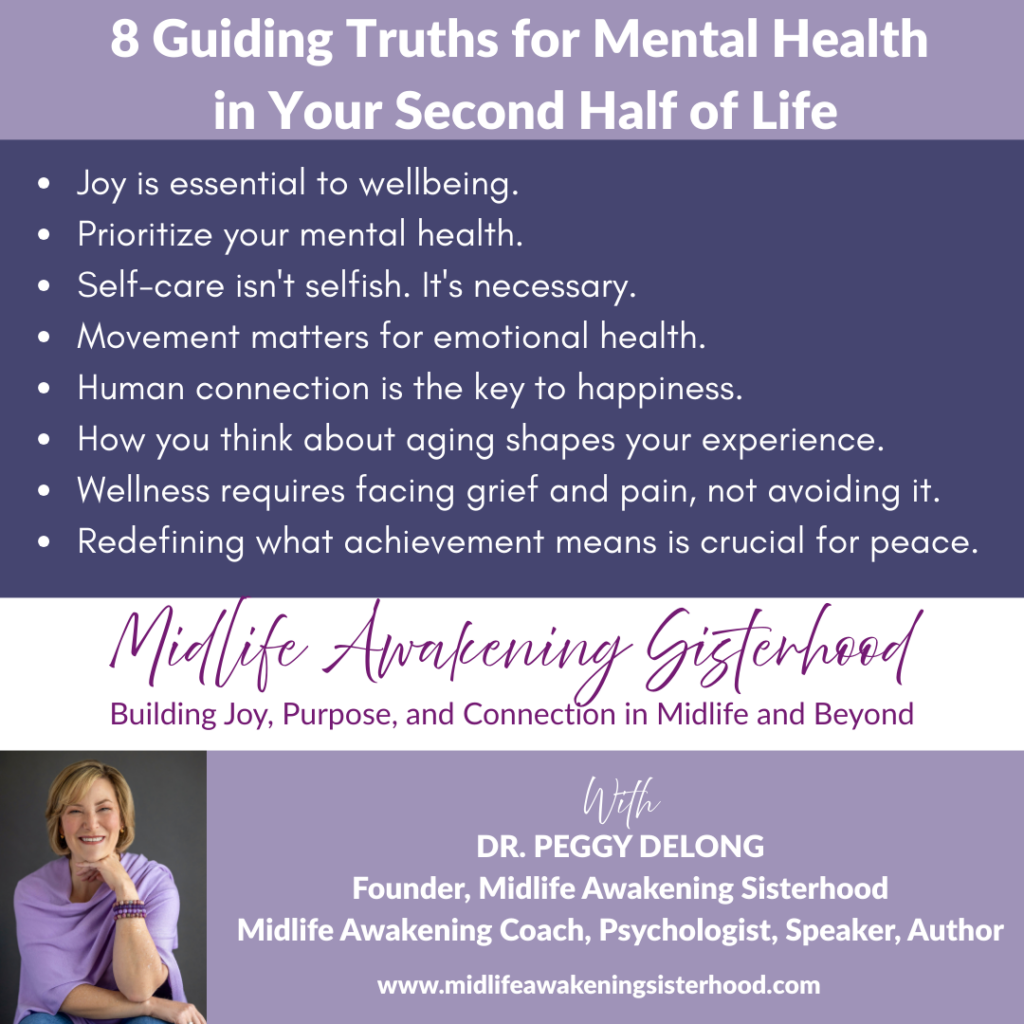
There are a few guiding truths that contribute to wellbeing in your Second Half and shape everything we do in the Midlife Awakening Sisterhood – a transformative 3-month program.
Guiding Truth #1 – You need to prioritize your mental health.
Positive mental health doesn’t just happen. No one else can do it for you. Think of it as your job. This is where the framework of The 4 Ps helps you to remember – Prioritize, Plan, Practice, Prosper.
Prioritize your mental health.
Plan health-promoting activities.
Practice them often.
Prosper, even during difficult times.
In the program, I dispel myths about happiness, help you identify what you’re doing that’s harming your mental health (you might be surprised!), teach the health-promoting ideas and tools, and support you in implementing them into your unique life. And you don’t do this alone. The Sisterhood supports you in the weekly group sessions. I support you in your 1:1 sessions.
Guiding Truth #2 – Joy is essential for wellbeing.
When life gets busy or stressful, joy is the first thing to go, at a time when you need it the most. You get to this stage of life where you’ve been so busy working, raising children, and taking care of other people, that you don’t even know what brings you joy any more. Or you feel blah, disconnected from joy, and quietly wonder why the things you once loved no longer light you up.
You need to intentionally create time for joy, not find time for joy – and not rely on others to do this for you. Your joy is your responsibility. The Prioritize P.E.A.C.E. Methods helps you prioritize joy, often in the simplest of ways, start feeling again, and awaken to your beautiful life. Women in the program love the “My Joy Plan” tool – providing a step-by-step process to infuse joy back into your life, and possibly discover it in ways you never thought possible!
Guiding Truth #3 – Moving your body isn’t just for your physical health. It’s a crucial component of your emotional wellbeing.
You know that exercise is important for physical health. In the Sisterhood, you learn how it’s crucial for your emotional wellbeing. Once again, no one can do this for you. It’s your job. Movement helps to decrease symptoms of stress and anxiety and mitigates midlife stressors. Feeling flexible and strong, the release of those “feel good” neurotransmitters, harnessing what I call The Trifecta of Exercise in Nature (water, trees, awe) – all of this and more – to support you in moving your body in ways that feel good for you.
Guiding Truth #4 – Human connection is the key to happiness.
All relationships matter. Friends, family, coworkers, and even strangers. The quality of our relationships is the strongest predictor of happiness. Cultivating relationships takes intention, yet many neglect this aspect of life, leading to loneliness. There’s a loneliness epidemic in the world, and it’s crucial to address it – it not only affects your emotional wellbeing, it has a negative impact on your physical health. Research indicates that it actually predicts how long you will live!
In an era where technology facilitates connections, people often feel more isolated. Nurturing existing relationships and making new ones doesn’t require extensive time or energy; it simply demands intentionality in every interaction. In the Sisterhood, you learn creative and fun ways to deepen your relationships – all of them, even strangers – because all relationships matter. In fact, recent research demonstrated that connecting with strangers was just as powerful for emotional wellbeing as your close circle of friends. You’ll learn why “There’s No Such Thing As Small Talk,” and why talking to strangers matters. We honor how talking to strangers feels awkward, and making friends as an adult? That’s its own special kind of hard. There’s something about it that can take you right back to scanning the middle school cafeteria, wondering where to sit.
Guiding Truth #5 A positive mindset about aging is crucial for your wellbeing.
A positive mindset about aging is crucial for wellbeing because our thoughts shape how we experience this season of life. Your mindset influences your behavior, resilience, and even your physiology! When you view aging as a time of loss and decline, your brain and body are more likely to experience those outcomes. When you choose a more resilient perspective, one that honors growth, curiosity, wisdom, and possibility, you we strengthen your capacity to adapt, cope, and thrive. In other words, the story you tell yourself about aging quietly shapes how you actually age.
You’re not left alone to figure this out! I’ve created an entire module to support you, including teaching you about what I call The Unkind Mind, and what to do about it.
Guiding Truth #6 You cannot ignore grief or emotional pain.
You cannot heal what you don’t feel. Also, when you shut yourself off to emotional pain, you are unwittingly closing yourself off to the fullness of joy. Yet you might arrive to midlife with the message that ignoring your pain is the way to feel happy, or know that you need to feel, but not have the tools.
Coping with ambiguous grief is a big task in midlife. All the intangible losses – changes in identity due to career shifts and roles ending, relationship changes, adult children moving out, your body’s changes, and the world simply isn’t what it used to be.
While it’s not helpful to try to relive those times, or be stuck in nostalgia, it is crucial to feel and process this ambiguous, often disenfranchised grief. It’s real. Don’t talk yourself out of your feelings. Learn to grieve what no longer is and can never be again, AND create a life you love to wake up to. They’re not mutually exclusive.
An essential component of the Prioritize P.E.A.C.E. Method is what I call The Positive Mindset Grid. True positive mindset and mental health is so much more than trying to think positive all the time, or following the latest social media influencer who tells you to “choose happiness.”
Yes, positive thinking is important for mental health, yet that is only one quadrant of the grid. You also need to address: 1) those pesky negative thoughts (we all have them and I teach you to gain awareness of the common ones that steal your joy and what to do about it), 2) feel and process painful emotions, and 3) know how to bring up your mood.
Don’t worry! You don’t have to do this alone! This is all covered in the Midlife Awakening Sisterhood!
Guiding Truth #7 Self-care is not selfish. It’s necessary.
You’re empathic. Giving to others is associated with positive mental health. For optimal wellbeing in your Second Half, it is important that you look at empathy in a new way, starting with yourself. Self-compassion. Empathy for yourself. Taking care of your own emotional needs, as well as your physical needs (sleep, nutrition, etc). This is an entire module in the Prioritize P.E.A.C.E. Method – E for Empathy, starting with understanding what I call The Empathy Hierarchy and The Empathy Error. Then you’re in a better position to give to others in a way that is sustainable, feels good, and fuels your wellbeing, rather than detracting from your wellbeing.
Guiding Truth #8 Redefining what achievement means is essential for your wellbeing.
A sense of achievement is connected to wellbeing. Now is the time to redefine what that means so that you’re not stuck in the high-achieving cycle, and can actually enjoy your life. So that your self-worth is not attached to “big” achievements. So that you celebrate “small” wins, and enjoy the journey, rather than only celebrating at the end.
Your desire or innate drive to learn doesn’t stop in midlife. You don’t stop growing. Now is the time to focus on doing so joyfully! A new recipe, that art class you always wanted to take, learning to play the piano, a new hobby, learning a new language.
You learn the 3Ps to Combat the High-Achieving Cycle and connect with the Present, Pleasure, and your unique Purpose. And you’re not alone if you also need to redefine your purpose – the program helps with that too!
The Midlife Awakening Sisterhood is growing, enrollment is open and ongoing, and we welcome you with open arms. If any of these truths resonate with you, I invite you to check out the program and if you think: 1) “Heck, yeah! This is for me!” – then sign up right away and schedule your first 1:1 session with me, or 2) If you think, “I love this! But I have one question…” then send me a message, and we’ll set up your call for you to learn more.
Click HERE to join the Sisterhood and make your Second Half fulfilling, joyful, and connected!
In Gratitude,
Dr. Peggy
The Gratitude Psychologist and Founder, Midlife Awakening Sisterhood
Leave a Reply